Scott Galloway describes the US economy as “one big bet on AI“, with AI-related stocks since 2022 registering 76% of the S&P 500’s return, 87% of earnings growth, and 90% of capital spending growth. He names three scenarios: The AI bubble bursts. AI delivers as promised, but on a slower timeline. Or, AI disrupts faster than we can adapt.
Andrew Yang, Kevin Roose, and Casey Newton put it plainly on a recent Hard Fork episode: the AI sector is not well liked, job displacement will make matters worse, universal basic income (UBI) is maybe a solution, and no check replaces the structure a job provides. This thought piece lays out a “how” we can move forward, for AI companies and our communities.
I’ve been building the “how” for years: as an international lawyer-consultant, VR startup exec, and advisor to faith and public leadership development programs in DC, and from 2013-2025 alongside the Mexican NGO PSYDEH and marginalized partners organizing our own economic mobility. Since late 2024, I’ve been developing the next iteration with a prominent regional civic leader in Northeast Ohio. I am also executive producing the 2027 Mexican documentary Embroidering Life on identity, purpose and women leadership, demonstrating the cinematic storytelling methodology we can deploy.
Our thesis: no-strings-attached, hand-up investment in our communities doing for themselves. No charity. No infantilizing. A third lane that communities design and run themselves.
The Problem Yang, Roose, Newton, Galloway Name
Leading AI companies build programs like Anthropic’s Claude Corps, Open AI’s People-first AI Fund Meta’s Workforce Academy, and the sector-wide supported Raise US. At best, these are well-intentioned efforts that reach individuals but don’t measurably improve their lives in the short term. There are no AI sector sponsored mechanisms to spread the wealth as inequality grows.
Yang names what a job actually is: structure, purpose, community, somewhere to go in the morning. Newton’s question follows: people who lose all of that won’t be made whole by a monthly allowance, even after the checks start rolling out. Roose notes, jobs apocalypse or not, the disruption is real. The window to mitigate this is now.
The AI bet looks like $400B+ invested in 2025, over $1 Trillion globally in 2026, $581B in the USA alone. Anthropic’s CEO estimates: 50% of entry-level white-collar positions eliminated. Yang’s projection: 20-30% of 70 million white-collar workers in five years. Communities already strained by inequality must absorb more disruption with no common-good mechanism offered.
Leaders on the right and left know we need to do something. UBI may be necessary, but is insufficient and feels fantastical. It gets traction on both sides: President Trump signed an executive order to develop a US sovereign wealth fund; Senator Sanders goes further with the American AI Sovereign Wealth Fund Act, calling for 50% equity transfer from OpenAI, Anthropic, and xAI to a public fund. This would deliver checks and give citizens a stake in sector success, but checks build no belonging.
We keep treating inequality like a technical problem best solved by experts. Challenges like workforce preparedness gaps, unequal home and business ownership, food insecurity, limited tech access are real, but they are symptoms. The root cause of inequality in democracies is a citizenry unaware of their power and that their rights come with responsibilities.
When citizens disengage, elites take over. The result is unchecked power of the private sector and the state. Faced with systems built without them in mind, vulnerable people create their own hidden economy and decide not to vote. Tocqueville saw it coming two centuries ago. He called it “tutelary power”, a guardian authority that doesn’t terrorize. It infantilizes. Keeps citizens in perpetual childhood, sparing them the friction of thinking and choosing and engaging difference. The unregulated attention economy organized around the algorithm is a modern delivery system: no uniforms, no visible hand, but isolated attention that is monetized and addictive.
Tocqueville’s warning is not the only one we must heed in 2026. Hannah Arendt identified a companion threat: when lies come faster than truth can respond, people stop trusting their own judgment. Not believing anything, disorientation, and inaction follow. Algorithm-driven slop is her nightmare coming true in 2026. Public officials performing for the same platforms accelerate it. “If I feel overwhelmed and I don’t see how I matter,” the reasoning goes, “why organize?“
The Behavioral Hypothesis
Sustainable shared prosperity requires shifting power directly to local groups through ground-up attention building and economic and political rights work. Michael Fullan and Joanne Quinn put it plainly: people closest to the problems are best positioned to solve them by strengthening the base, mobilizing the middle, and intriguing the top. This works.
The mechanism is relationship building. Daniel Siegel’s Interpersonal Neurobiology, myriad sources of our best leader training programs, the 60-year evidence-based Re-Education (Re-ED) model building resilient young people–all show that relationships rewire neural structure and mental framework at any age or station.
Discernment through question thinking and active listening is our human superpower, slowing time down, moving people from judger to learner, from isolation to belonging. john powell’s formulation: poverty (mental and economic) is fundamentally about exclusion. Create belonging, reduce poverty. Salon Cultivar, my 2025 Strother School for Radical Attention Community Organizing Fellowship proof-of-concept in Northeast Ohio, is testing these mechanisms at the local level. In eight months of convenings, cross-sector experts (politics, health, education, civic engagement) want language for what they’re already seeing and feeling, and the body and heart — community as a sanctuary space — where we can tend as much as the mind.
Two paths get named in this AI-common good debate: put money in people’s hands (this works), or guarantee jobs (paternalistic and unamerican). The Center for Sustained Prosperity is the sweet spot: citizen demand oriented, no-strings-attached, hand-up investment in groups doing for themselves. We start in Cuyahoga County, with a model designed to replicate across the US.
Proof of Concept: PSYDEH and Say Yes Cleveland
From 2013-2025, I built the Mexican non-profit PSYDEH from a one-person CSO into a globally recognized NGO. Results: 19x financial and 62x total contribution growth; thousands of direct and indirect beneficiaries; Fortune 500 partnerships with 3M, Adobe, Viasat, and Zoom; recognition from Fast Company, GlobalGiving, Anthem Awards. All during sector-wide contraction.
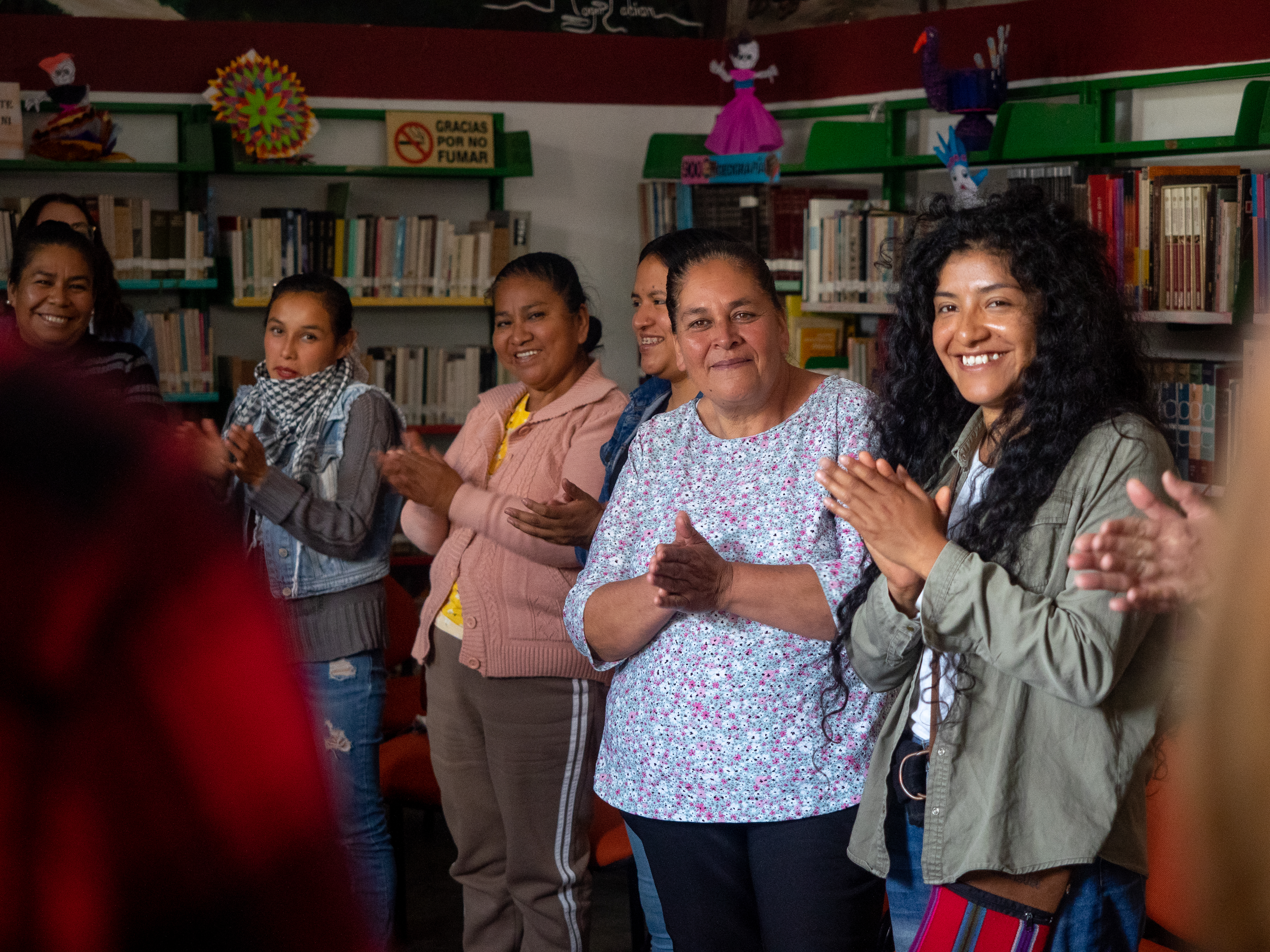
83% of PSYDEH’s women partners surveyed report needing economic, tech, and leadership opportunities, and they are ready to build it together. In the Red Sierra Madre network, 60 women lead economic collectives that bring in revenue and produce community-impact projects. They make smart demands of government to drive their own economic development. The team walks with them throughout.
The behavioral lessons are transferable: (A) Consciousness precedes being (Havel, 1990). Human relationships — with self and others — are critical to change and best formed through in-person contact rooted in specific disciplines. (B) Continuous, local-based coaching is vital for sustained growth. (C) Investing directly in people building their own projects undergirds longer-term solidarity work.
The multi-generational Say Yes Cleveland model shows we have what we need to do big swings in Northeast Ohio. This has been the case for some time (Cleveland Now). We know what stands in the way. The Center is built differently: independent of politics and administration cycles, smaller scale but county-wide, fail-fast pilots, community-led from the ground up. For example, in year six (2025), and despite an unexpected leader transition in 2023, SYC’s first college-going cohort (class of 2019, without the full benefit of K-12 wrap-around services) is already posting meaningful gains on college applications, continued enrollment, and graduation rates compared to prior cohorts.
The Center in Context: Three Lanes of Action
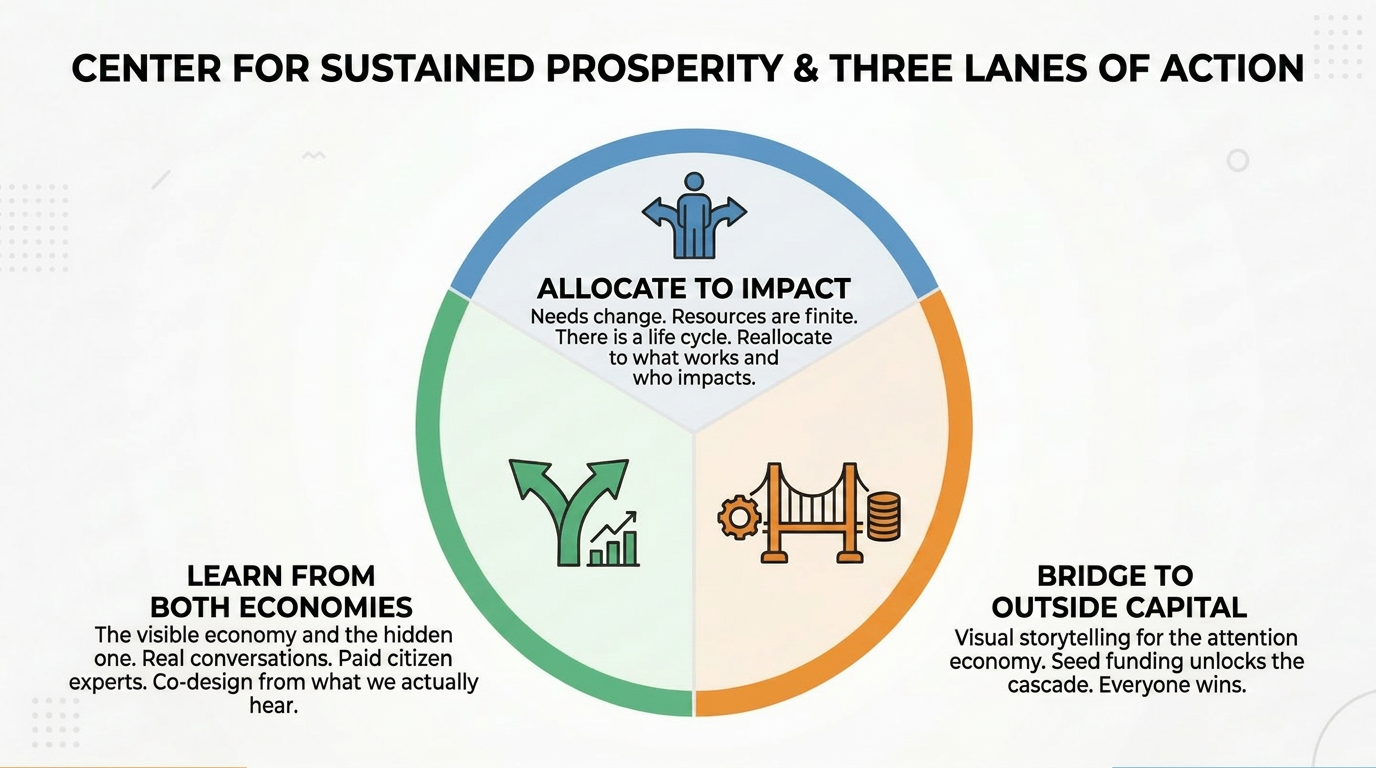
The Center is designed as a new product for an existing institution, keeping costs down and giving the fiscal sponsor a new impact platform. It operates within three lanes of existing action in NE Ohio.
Allocate to impact. Not every institution doing good is the right vehicle for what comes next. Resources are finite; life cycles end. We map what works, allocate to who impacts, and are honest about what needs to sunset or merge. With policy retreat at the state and federal level, every choice is bad. This is impossible work. The Urban Agenda, with 14 of the county’s largest institutions, maps out one way forward by building ecosystem understanding around Black and Brown homeownership, business ownership, and workforce preparedness.
Learn from and do with both economies. Understand the visible one in wealthy urban areas and suburbs and the hidden one that 43% of the county’s households, more than 233,000, falling below the ALICE threshold build for themselves. The hidden economy investigation lies at the core of the Center’s work: real conversations on what is done and needed; paid story-gathering facilitated by trusted community leaders (expert consultants earning an industry-standard wage); 4-5 distinct profiles emerging from what we actually hear. We co-design fail-fast pilots from what surfaces.
Use buckets one and two as the evidence base for harnessing local resources and attracting outside investment. Visual storytelling built for the attention economy: cinematic, data-based case studies told by partner beneficiaries themselves. This bridges city to suburb, local to global capital. Fellowship and local seed investment first, signaling their commitment to the AI sector. AI sector investment signals to Fortune 500. Fortune 500 signals to ultra-wealthy philanthropy. Each tier watching the next. Proved in Mexico and Cleveland. Films like Embroidering Life, currently in production, showcase the fruits from this work.
The strategy: walk slow to run fast. Year 1 prioritizes proof-of-concept credibility, building systematically to 6:1 leverage by Year 3. It’s a three-year start-up inside a multi-generational commitment to empowering families with children (and their neighbors) to create home-grown emergent solutions.
Even if the Center doesn’t scale past Year 1, the seed produces durable wins: nationally applicable hidden-economy research, a replicable pilot, multi-stream funding lessons, a cinematic case study on community-led development in post-industrial USA.
AI and the Center: Futures Intertwined
AI is inevitable. Greater Cuyahoga County has carried stubborn poverty and inequality for 50+ years and now must absorb fresh disruption from Columbus, DC, and AI. We are dynamic and active, not broken. We need a hand up, not a hand out. The Center is a cross-sector framework under active consideration by Northeast Ohio philanthropic and civic leadership and national institutions.
It directly addresses what Galloway, Yang, Roose, and Newton identify but cannot solve: UBI, ownership stakes, regulation — none build belonging. The Center documents what our communities do economically (the hidden economy) and builds development ecosystems from this shared reality, strengthening what works and replacing what doesn’t.
Why AI Companies Can Co-Build
AI labs are neither saviors nor villains. They are companies. All believe in their product and compete fiercely to win. Some genuinely want to help. Most do all three. More than 1,300 AI workers, including Anthropic’s Dario Amodei, call for government guardrails. But good intentions are nice sentiments. The space race blazes on. AI’s approval rating is 26% and will worsen without proactive common-good investment.
From Virginia to Arizona, activists stalled $98 billion in data center projects in a single quarter in 2025 alone. The opposition is organizing, bipartisan, and gaining ground in 2026. The ROI of getting ahead of this is significant.
LLM/AGI is built on citizen digital property with no compensation. Top AI companies in the “moon race” offer 8-9 figure salaries and bonuses. SpaceX, Anthropic, and OpenAI are completing the biggest IPOs ever at $1 Trillion or more per offering, with altered rules ensuring average citizens buy in through index funds and retirement accounts, whether they choose to or not. Yet unlike the postwar highway system with comparable capital and universal benefit, AI offers no specific common-good return, even as thousands lose jobs and states slide toward recession.
If AI transforms the economy the way rail did, forward planning must include targeted investment in communities doing for themselves alongside investment in future energy and computing power. It strengthens the talent pipeline, surfaces new AI use cases, and heads off a PR disaster.
Community investment hedges the bet, building public trust and real-world AI solutions while the AGI timeline plays out.
The exact structure and program of the Northeast Ohio Center work is for the planning committee we are forming. At minimum, three value propositions for AI sector co-builders:
Belonging-focused work. Proximity is everything. The hidden economy investigation humanizes economic development, building the trust and shared prosperity the tech and adjacent sectors need with citizens.
Local economic mobility. Ground-up, measurable proof that AI enables communities to solve their own problems. Specific investments in the common good in lieu of top-down tech solutions.
Tech talent training pipeline. Future AI employees and customers grown through business and home ownership pilots, workforce prep, and AI tool adoption for micro-entrepreneurs. Ground-level engagement is where practical AI uses get proofed against the daily lives of everyday people.
Cuyahoga County, OH has everything the sector needs: a post-industrial area building its own economic transformation (replicable); generous citizens (ranked #1 among major US metro areas for giving to human services (Fidelity Charitable, 2023)) and a strong institutional coalition of investors and tech-adjacent community-led development; measurement infrastructure with outcomes-based accountability. The alternative? Wait for the PR disaster, then scramble in crisis mode, paying double or triple for much less goodwill and AI-driven impact.
Seed Funding Unlocks the Four Funding Streams
The Center does not rely on any single funding stream. Nobody wants to be first. Seed funding breaks the deadlock, giving us the runway to work both angles simultaneously. Local actors watch for outside investors; AI companies watch for local traction. Once seed is in, the cascade follows: each tier confirms the next, in sequence or in parallel.
- Local investors: Boomer generation legacy building, mid-market corporate workforce pipeline investment, foundation partners, and, eventually, a social impact bond at tiered recognition levels.
- The AI sector: Anthropic’s Long-Term Benefit Trust, Google Philanthropy, the OpenAI Foundation. The Center offers a replicable, outcomes-accountable proof case that AI can enable community resilience rather than community collapse: shaping citizen-AI sector relationships, mitigating risk, and building the next talent pipeline.
- Fortune 500 companies: ESG, CSR, social impact investment in measurable outcomes. PSYDEH’s track record proves the shared-value model produces ROI alongside genuine social impact; it transfers to Northeast Ohio. This is good for bottom lines and communities simultaneously.
- Ultra-wealthy philanthropy: MacKenzie Scott’s $16.5B no-strings model is the new standard. Trust-based giving, localization, no middle agents. Blue Meridian ($4B) and Co-Impact ($800M) facilitate multi-donor, national-local co-investment.
The Center’s target leverage goal: 6:1 by Year 3, or $10.2M mobilized on a minimum $1.7M invested. We hit the threshold or reassess after each year. Under-promise and over-deliver.
Build a seat at the table
A 50-year impact maker in Northeast Ohio recently told me: if no one follows up, this is likely because you don’t have the power folks need to achieve their goals, not because the idea or you are wrong. Power comes through connections, money, or both. You don’t wait for someone to give you a seat at the table. You build it.
Yang asks: how do you spread the wealth?
The answer lives in Americans doing for themselves. Built from a hand up, designed with communities, not for them. A “we,” not “those people”. Voting rates begin to tick up because people feel seen, like they belong. The poverty rate (16.1% in Cuyahoga County today, against an Ohio average of 13%) ticks down for the first time in a generation. A seat at the table must be built. We are building it.
We invite Year 1 partnerships for a 2026 launch. If you’re in the AI sector or the impact-investment space and want to explore what co-building looks like, let’s talk. damon@damon-taylor.com.
