Thinker-doers like Scott Galloway call it “America is one big bet on AI, with AI-related stocks since 2022 registering 76% of the S&P 500’s return, 87% of earnings growth, and 90% of capital spending growth. Now, as he says, we have three scenarios: The AI bubble bursts; AI delivers as promised, but on a slower timeline; and AI disruption comes faster than the market can adapt and respond.
Andrew Yang, Kevin Roose, and Casey Newton put it plainly on a recent Hard Fork episode: the AI sector is already not well liked, job displacement (if it happens) will make matters worse, UBI is maybe a solution, and a job is structure, purpose, community; no check replaces that. They name the challenge-opportunity. This essay builds out a how we move, for AI companies and USA communities.
I’ve been building the how for years. As an anti-poverty community organizer in Cleveland, and international lawyer-consultant, virtual reality startup exec, and advisor to faith and public leadership development programs in DC, I built the conceptual scaffolding. Between 2013 and mid-2025, alongside rural and Indigenous women in Mexico organizing their own economic collectives and communities, we built the proof. In late-2024, Eric Gordon, now CEO Positive Education Program (former CMSD CEO), and I began building the next iteration for post-industrial America.
The Problem Yang, Roose, Newton and Galloway Name
Yang: “[A] job is structure, purpose, fulfillment, community, a place to go in the morning.” Newton: “I’m wondering if the loss of all of those other things is going to result in [people] ultimately not being all that happy with AI companies, even after the checks start rolling out.” Regardless of whether there is a jobspocalypse, or UBI, there is massive investment in AI and disruption. And there are no mechanisms to spread the wealth as inequality levels grow dramatically across the country.
The AI bet looks like $400B+ invested in 2025. Anthropic’s CEO estimates: 50% of entry-level white-collar positions eliminated. Yang’s own projection: 20-30% of 70 million white-collar workers in five years. Right or wrong, our communities absorb this disruption with no common-good mechanism offered. UBI is necessary, insufficient, and maybe fantastical.
The dominant paradigm still treats inequality as a technical problem best solved by experts. Problems like weak workforce preparedness, unequal homeownership, food insecurity, and limited access to technology are real but symptoms. The root cause of inequality in democracies is a citizenry unaware of their power and that their rights come with civic responsibilities.
When citizens disengage, elites take over. The result is unchecked power of the private sector and the state. Faced with marginalization and algorithmic capitalism, vulnerable people create their own hidden economy and decide not to vote. Too many feel alone and abandoned. “If I don’t see how I matter,” folks reason, “why organize?”
The Behavioral Hypothesis
Sustainable shared prosperity requires shifting power directly to local groups through ground-up attention building and economic and political rights work. Michael Fullan and Joanne Quinn put it plainly: people closest to the problems are best positioned to solve them by strengthening the base, mobilizing the middle, and intriguing the top. This works.
The key is relationship building, drawing from Interpersonal Neurobiology built around Daniel J. Siegel’s work. Relationships change our neural structure and mental framework at any age or station.
The behavioral mechanisms are specific: question thinking and active listening slow time down, removing the hurry, the urgency, that always clouds. They shift participants from the judger mindset to the learner mindset, from isolation to belonging. john powell’s formulation: poverty — mental and economic — is fundamentally about exclusion. Create belonging, reduce poverty.
In a climate-change-battered, hyper-connected, and information-overloaded world, resilience through human relationships is everything. Two paths are named: put money in people’s hands (this works), or guarantee jobs (paternalistic and unamerican). The Center for Sustained Prosperity is the sweet spot. We can do UBI, yes. We can also do no-strings-attached, hand-up investment in groups doing for themselves. We’ll first start in Northeast Ohio, then across the country. No charity. No infantilizing.
Proof of Concept: PSYDEH and Say Yes Cleveland
From 2013 – 2025, I built the Mexican non-profit PSYDEH from a one-person CSO into a globally recognized NGO. Results: 19x financial and 62x total contribution growth; Fortune 500 partnerships with 3M, Adobe, Viasat, and Zoom; recognition from Fast Company, GlobalGiving, Anthem Awards. All during sector-wide contraction.
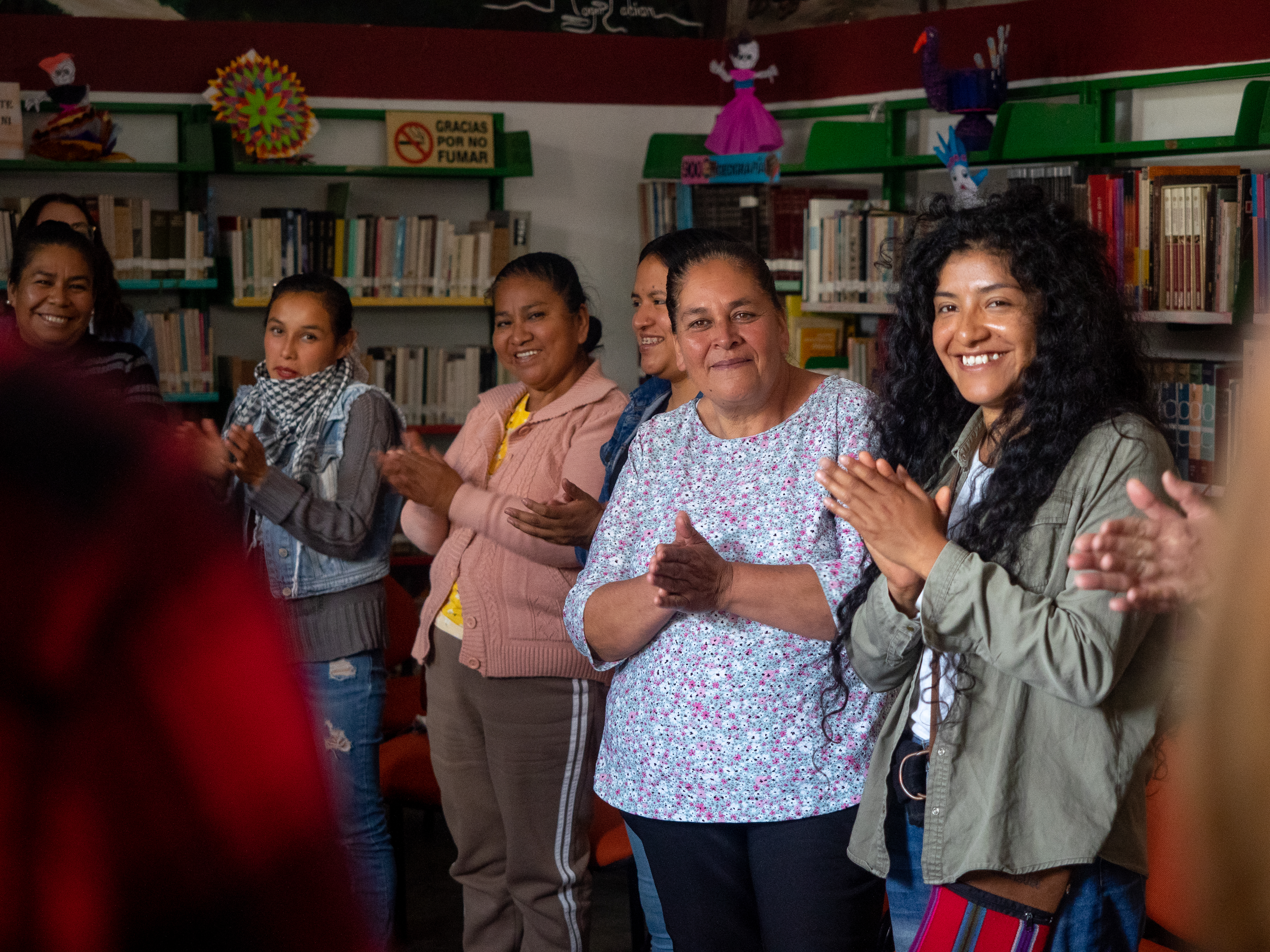
83% of PSYDEH’s women partners surveyed report needing economic, tech, and leadership opportunities, and they are ready to build it together. In the Red Sierra Madre network, 60 women lead economic collectives that bring in revenue and produce community-impact projects. They make smart demands of government to drive their own economic development. The team walks with them through the hardest stretches.
The behavioral lessons are transferable: (A) Consciousness precedes being, as Havel reminded the USA congress in 1990. Human relationships — with self and others — are critical to sustained systemic change and best formed and transformed through in-person contact rooted in specific disciplines. (B) Continuous professional coaching is vital for empowerment. (C) Investing directly in people building their own projects sustains longer-term solidarity work.
This 12-year cycle reveals something essential: sustainable community transformation requires a specific process that can be adapted across contexts while maintaining core principles of human flourishing and citizen-led economic and political rights work. It’s hand-up work. Done right, this resonates with local, national, and global donor-investors. The 25-year generational initiative Say Yes Cleveland model (shepherded forward by Eric Gordon) shows we have what we need in NE Ohio.
The Center for Sustained Prosperity in a Three-Quadrant Ecosystem
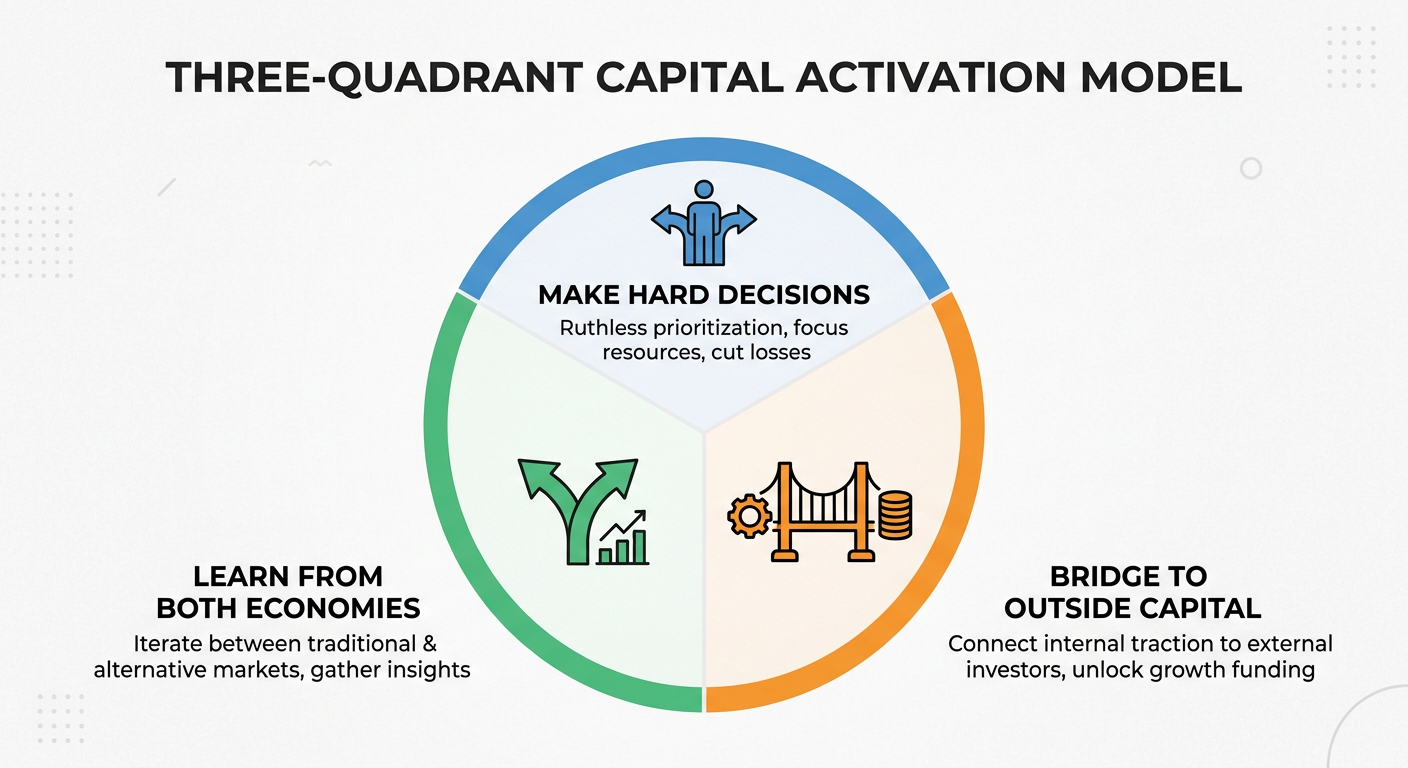
The Center operates within a three-part framework shaped by what actually moves systems.
Make hard decisions. Not every institution doing good is the right vehicle for what comes next. Resources are finite. There is a life cycle. We map what works, allocate resources to what and who impacts, and are honest about what needs to sunset or merge. This 100% is all-choices-are-bad work. We do it anyway. The Urban Agenda, with 14 of the county’s largest institutions, is in this space.
Learn from both economies simultaneously. We must understand the visible one in wealthy urban areas and suburbs and the hidden one that ALICE-threshold families with children build for themselves. The hidden economy investigation lies at the core of the Center’s work: real conversations, not surveys; paid story-gathering facilitated by trusted community leaders; 4-5 distinct profiles emerging from what we actually hear. We co-design fail-fast pilots based on what we hear.
Use buckets one and two as the evidence base for harnessing more local resources and attracting outside investment. Visual storytelling built for the attention economy. Cinematic case studies, not reports. This bridges our doing to national and global capital. Local discipline and investment first. Outside investment follows. Everyone wins. Proved in Mexico and Cleveland.
The strategy is walk slow to run fast: prioritize Year 1 proof-of-concept credibility over capital volume, building systematically to sustainable 6:1 leverage by Year 3. It’s a three-year start-up inside a 25-year generational commitment to empowering citizens to create home-grown emergent solutions. Even if the Center does not scale beyond Year 1, the seed investment still produces big wins: published hidden economy research applicable nationally, a pilot proof-of-concept on which future builders can build, multi-stream funding model lessons for the civic sector, and a compelling audio-visual story on community-led development.
AI and the Center: Futures Intertwined
AI is inevitable. While our greater Cuyahoga County has struggled for 60+ years, and now must absorb disruption and displacement, we are dynamic, active, not broken, only needing a hand up. Co-developed with Eric Gordon, the Center is a cross-sector framework under active consideration by NE Ohio philanthropic and civic leadership and national institutions.
The Center directly addresses what Galloway, Yang, Roose, and Newton identify: not just cash, but the infrastructure of belonging. We document what our communities do economically (the hidden economy) and build a new development ecosystem from the ground up, based on shared reality.
Why AI Companies Will Co-Build
AI’s approval rating is 26% and it’s going to get worse without proactive common-good investment. The ROI of getting ahead of this is significant.
LLM/AGI is built on citizen digital property with no compensation. Top AI companies in the “moon race” offer 8-9 figure salaries and bonuses. Yet, unlike when we invested similar amounts in the USA highway system that benefited every single US citizen, there is no specific common good benefit offered by AI, even still with 1000s losing jobs and states going into recession.
If AI transforms like the railroad sector did, and the numbers are real, the sector needs to include in its forward planning targeted investments in communities doing for themselves. Like futures investments in future energy sources and computing power capacity, this strengthens the talent pipeline and heads off a massive PR disaster.
The NE Ohio-based Center offers three specific value propositions for AI sector co-builders:
Local economic mobility. Ground-up, measurable proof that AI enables communities to solve their own problems. Not top-down tech solutions.
Belonging-focused work. The hidden economy investigation humanizes economic development, building the trust and shared prosperity the tech sector needs with citizens.
Tech talent training pipeline. Creating future AI sector employees through business ownership pilots, AI tool adoption for micro-entrepreneurs, and community organizing for tech literacy.
Cuyahoga County, OH has everything the sector looks for: a post-industrial area building its own economic transformation (replicable), a strong institutional coalition of investors, tech-adjacent community-led development, and measurement infrastructure with outcomes-based accountability. The alternative? Wait for the PR disaster, then scramble in crisis mode, paying double or triple for much less goodwill.
Capital Activation: The Four Streams
The Center does not rely on any single funding stream. Four streams, activated in sequence. Nobody wants to be first. Local actors watch AI companies; AI companies watch local actors. The key to unlocking potential is who steps first.
Local investors: Boomer generation legacy building, mid-market corporate workforce pipeline investment, foundation partners, and, eventually, a social impact bond at tiered recognition levels.
Fortune 500 companies: ESG and CSR investment in measurable outcomes. The PSYDEH track record proves this partnership model produces ROI alongside genuine social impact. The same shared-value ecosystem model transfers to Northeast Ohio. We move from ego-system to ecosystem, good for bottom lines and communities simultaneously.
The AI sector: Anthropic’s Long-Term Benefit Trust, Google Philanthropy, the OpenAI Foundation. The Center offers a replicable, outcomes-accountable proof case that AI can enable community resilience rather than community collapse. We shape citizen-AI sector relationships, mitigate risks, and build the next talent pipeline.
Ultra-wealthy philanthropy: MacKenzie Scott’s $16.5B no-strings model is the new standard. Trust-based giving, localization, no middle agents. Blue Meridian ($4B) and Co-Impact ($800M) facilitate multi-donor, national-local co-investment.
The Center’s target leverage goal: 6:1 leverage by Year 3, or $10.2M mobilized on $1.7M invested. Our goal is not aspirational. It is a performance threshold. We hit the goal or reassess after each year. Under-promise and over-deliver.
Build a seat at the table
Yang asks: how do you spread the wealth?
The answer lives in communities doing for themselves. It is built from the ground up, designed with communities, not for them. A “we”, not “the other” or “those people”. Voting rates begin to tick up because people feel seen, like they belong. The poverty rate (16.1% in Cuyahoga County today, against an Ohio average of 13%) ticks down for the first time in a generation. A seat at the table is not given. It is built. We are building it.
Interested in co-building or learning more? damon@damon-taylor.com
