Effective leaders in diverse communities don’t just manage difference—they leverage it as a strategic asset. Building bridges across culture, race, and class boundaries is particularly important for Ohio and other US leaders navigating post-industrial transitions where success depends on forging new alliances between traditional industries, emerging sectors, and diverse communities.
Visual storytelling–through film, photography, and animation–creates shared understanding across traditional divides that policy documents and data alone cannot achieve. These bridges help transcend objectification of “the other” and form the foundation of active citizenry—crucial for Ohio and other US leaders addressing complex challenges like economic development and building belonging requiring sustained collaboration.
PSYDEH’s Visual Storytelling Approach
At PSYDEH, we view creative processes and expressions as essential tools for building the relationships needed to make a sustainable impact.
FILM AND VIDEO
This series of six videos in ENGLISH and in SPANISH, or this 3-minute video ad from YouTube channel, show impact in 2022-2023 through the voices of our staff, local partners and company allies. These creative assets reveal who PSYDEH is and how we use technology to cultivate cooperation and connection.
Our 2021 short film “Poderosa” demonstrates strategic storytelling leadership: creating space for marginalized voices to tell their own stories while building broader support for systemic change.
In 2026, we release our first feature documentary made in the cinéma-vérité style by a global team of filmmakers telling the story of women working with women to decrease inequality from the ground up in Mexico.
PHOTOGRAPHY
Photography disrupts “other making” patterns by creating face-to-face encounters that build empathy and understanding across difference. With an image, we have a safe space for surfacing problems and presenting solutions.
IMAGE AS HUMANIZER
In the Americas, immigration discourse divides communities through “other making.” This dynamic exists through urban/rural divides and economic inequality. Strategic visual storytelling disrupts these patterns by creating face-to-face encounters that build empathy.
IMAGE AS BRIDGE BUILDER
These images invite dialogue—a generative tension that reveals shared humanity and transcends objectification, forming the foundation of active citizenship.

For example, viewers are more likely to positively engage with northern or rural-to-urban migration stories after seeing the iconic image “SPIRIT.” This Indigenous Veracruzana leader calls on her Indigenous peers from Hidalgo to embrace their unique role as public impact makers. This image captures truth that contradicts stereotypes about rural Indigenous women’s engagement.
“SINCERITY” and “CANDOR” show unscripted Otomí women leaders, reflecting authentic collaboration that promotes self-awareness despite centuries of marginalization.


“RISK” shows an Otomí woman leader owning her power before peers, demonstrating relationship building and community forging–democracy building, at its most human.
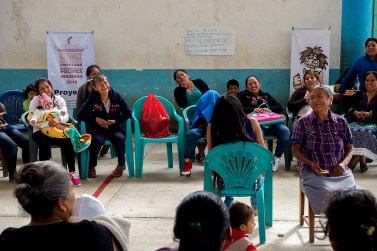
“OWNER” celebrates personal truth before power. This woman leader takes center stage at a regional public forum. Her goal? Own her voice, demonstrating how her people and opinions matter..

ANIMATION
Community-led development and cross-sector, shared value ecosystems are necessarily complicated. Our teaching and communication efforts are enhanced through animation like the below-animated lesson on our process-oriented, scalable model in action.
The rationale:
65% of people are visual learners (The McGurk effect), and presentations with visual aids are far more compelling. Our Route to Good collaboration with Dentsu helped us understand narrative as a tool for inspiring action across groups. Animation helps learners understand complex ideas, as demonstrated by TEDEd and The Atlantic’s increasing use of the medium.
Ohio / US Application
The US post-industrial landscape mirrors the challenges we’ve navigated in Mexico—communities divided by economic transition and inequality, geographic isolation, and cultural difference. The same visual storytelling strategies that helped the NGO and rural Indigenous women leaders claim their voices can bridge urban-rural divides and build the cross-sector alliances, authentic human connection, essential for sustainable regional development.

